
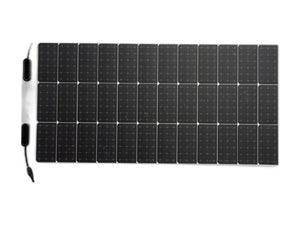
How much will a Black Series 150W flexible panel add to my HQ battery each day?
A panel's rating is what it makes on a test bench. On a roof it makes less, so the numbers below use the same assumptions as our RV solar and battery calculator: 75% real-world harvest and a 12V bank.
The arithmetic
- Real output in good sun: 150W x 75% = about 112W.
- Per sun hour: about 112Wh, or roughly 9.4Ah at 12V.
- Per day:
| Sun hours | Watt-hours | Amp-hours at 12V |
|---|---|---|
| 4 | about 450Wh | about 37Ah |
| 5 | about 560Wh | about 47Ah |
Cloud, shade from an awning or roof rack, and low winter sun all cut this. Treat the table as a good-weather day, not a guarantee.
What that means on an HQ
Our off-grid answer lists 600W of roof solar on the HQ models it covers. At the same assumptions, 600W makes about 1,800 to 2,250Wh a day, so one 150W panel adds roughly 25%.
The same answer puts a cold night of furnace blower at 40 to 60Ah. One 150W panel in good sun covers most or all of that. It will not change how long you can run the roof air conditioner off-grid; that load is far larger than any single panel.
Before you wire it in
The listing gives the panel's watts, size and weight but not its open-circuit voltage, short-circuit current or connector type. Read those off the label on the back of the panel and check two things against your existing solar charge controller:
- Current: the total array current, with the new panel added, must stay inside the controller's rated input.
- Voltage: if you wire it in series with the other panels, the total open-circuit voltage must stay under the controller's maximum input voltage, with margin for cold mornings.
If the controller is already near its limit, the panel needs its own controller. Send us the controller model and the panel label and we will tell you which way to wire it.
Fitting
At 2.5 mm thick and 6.6 lb, the panel bends to a curved roof where a framed panel will not sit. It mounts with its adhesive backing or through its pre-drilled holes.
Run your own numbers in the solar calculator before adding panels; our solar upgrade guide covers when a bigger battery is the better buy.
What you need
Want the full walkthrough? Read the complete guide.