
What fuse and wire size do I need for a Blue Sea 120A SI-ACR?
The 7610 is rated 120A continuous. You don't have to wire it for 120A, though. Wire and fuse it for the charging current your alternator will actually push through it. Blue Sea publishes this chart for the 7610:
| Charging amps | Minimum wire (AWG) | Fuse |
|---|---|---|
| 60A | #6 | 75-90A |
| 80A | #4 | 100-125A |
| 100A | #2 | 150A |
| 120A | #1 | 175A |
Blue Sea notes that the wire sizes are minimums. On a long run from the engine bay to a trailer or a rear house bank, voltage drop can call for a heavier wire. Never go lighter than the chart.
Two fuses, not one
The relay has two battery studs, A and B, and each one is wired to a battery positive. Fit a fuse on both cables, as close to each battery as you can. Blue Sea explains why: the fuses protect the wires between each battery and the relay if those wires are damaged. A fuse mounted at the relay end leaves most of the cable unprotected.
Which fuse type
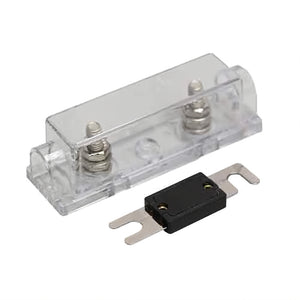
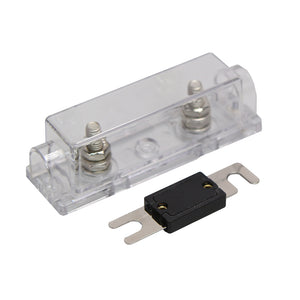
Both fuses connect directly to a battery, so the fuse must have enough interrupt rating (AIC) for that bank. Blue Sea names ANL, MRBF terminal fuses and MIDI/AMI as suitable types. We stock ANL fuse kits with holders in 100A and 150A. Those match the 80A and 100A rows above. For a full 120A run, the chart calls for 175A.
Example
Say your alternator can send about 100A to the house battery. That calls for #2 wire and a 150A fuse at each battery, so two 150A ANL kits.
Other wiring the 7610 needs
- Studs: 3/8"-16, torqued to 140 in-lb.
- Ground: a separate wire to one battery's negative terminal. The relay will not work without it.
- Kit option: the 120A Add-A-Battery kit (7650) pairs this same relay with an e-Series Dual Circuit Plus switch (5511e). The fuses are not included in either.
What you need


Want the full walkthrough? Read the complete guide.