
Do I need a charge controller with a portable solar suitcase?
It depends on what the suitcase plugs into. A charge controller takes the panel's raw output, which can be well above battery voltage, and turns it into a charge the battery can safely take. A power station has one built into its solar input. A bare 12V house battery does not.
Plugging into a power station
Leave the controller out. Run the panel straight to the station's solar input. The one check is voltage. The panel's open-circuit voltage must sit inside the station's maximum DC input. For a 47.2V panel like the 400W Lightweight suitcase, Renogy notes the station's input should be above 48V.
Charging the RV's 12V battery
You need a controller between the suitcase and the battery, plus cables and a battery fuse. Which kind depends on the panel's open-circuit voltage:
| Suitcase | Open-circuit voltage | Controller in the box? | For a 12V battery |
|---|---|---|---|
| N-Type Suitcase Kit 100W or 200W | 21.47V | Yes, Voyager 20A PWM | Ready to go. Set the Voyager to your battery type; for lithium, Renogy says set the system voltage manually |
| N-Type suitcase 100W | 21.6V | No | Suits a PWM controller |
| N-Type suitcase 300W | 30.3V | No | Needs an MPPT |
| Lightweight suitcase 220W | 23.3V | No | Add a controller |
| Lightweight suitcase 400W | 47.2V | Only in the 400W + 40A MPPT option | Needs an MPPT |
Which controller size
Our calculator picks the controller from the array's watts. Up to 220W it lists a SmartSolar MPPT 75/15 or 100/20. Up to 400W it lists the 100/30, and up to 700W the 100/50. Renogy's Rover 2 is a compact 20A MPPT for 12V or 24V with Bluetooth. Before you pair any controller with a bigger suitcase, check its rated watts at 12V and its maximum solar input voltage against the panel's open-circuit figure.
What it will put back
The calculator plans on 75% of a panel's rating times your peak sun hours. At 4 to 5 sun hours, that is about 300 to 375Wh a day per 100W. So a 200W kit gives about 600 to 750Wh, which covers a propane-fridge travel trailer's day with room to spare. A 12V compressor fridge rig at 750Wh or more needs the bigger panels.
If you have not settled on station or battery yet, start with the daily number. Run your own numbers in our RV solar & battery calculator. It shows the daily watt-hours, whether a station covers them, and the panel and controller to match.
What you need
-
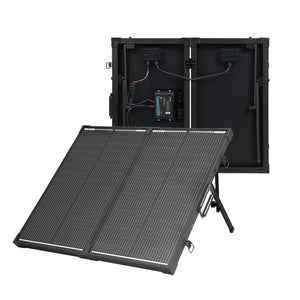 Renogy N-Type Solar Suitcase Kit 100W/200W, 20A PWM
$217.49
-
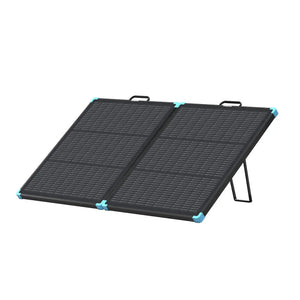 Renogy 100W/300W N-Type Portable Solar Panel Suitcase
$136.74
-
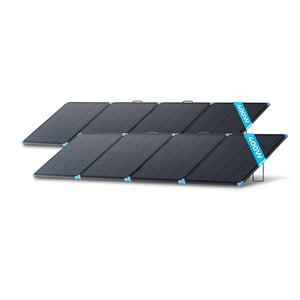 Renogy Lightweight Portable Solar Suitcase, 220W/400W
$273.93
-
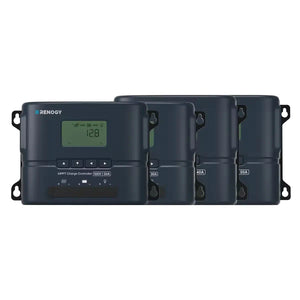 Renogy Rover 2 12V/24V 20A Compact MPPT Charge Controller | RCC-M10020-C2-US
$85.49
-
 Victron SmartSolar MPPT 75/15–100/20 | RV Solar Charge Controller
$59.00

Want the full walkthrough? Read the complete guide.