
Sterling VSR or current-limiting CVSR relay: which do I need with an RV inverter?
Sterling makes three relay families for joining a starter battery and a house bank. All three have about 0.01V drop and IP65 sealing. What separates them is what happens when the house side pulls a lot of current through the relay.
The three families
| Family | Ratings we stock | Switches on | Current limiting |
|---|---|---|---|
| IFR ignition feed relay | 12V: 80, 160, 240A. 24V: 50, 100, 150A | Ignition feed signal, 30-second start delay | None |
| VSR Pro Connect | 80, 160, 240A (12V/24V auto) | Above 13.3V by default; adjustable | None |
| CVSR current-limiting | 70, 140, 210, 280A (12V/24V auto) | Automatic by voltage; ignition feed optional | Yes |
Why the inverter decides it
While the relay is closed, the starter battery, alternator and house bank are joined through it. Sterling's own copy says a plain relay can burn out if a big load, like an inverter, pulls hundreds of amps through it, and its VSR and IFR listings both say to use a current-limiting relay where the house bank feeds big loads (the IFR copy names a large inverter, anchor winch or bow thruster).
The CVSR handles it in two steps: it first cuts the current through itself to about 6A, then opens, and reconnects automatically once the load is gone. It also has short-circuit protection before it engages.
Decision rule
- House bank runs an inverter, microwave, induction hob or a 12V air conditioner: CVSR. Sterling does not publish a sizing rule in our listings, so tell us your alternator output and inverter size and we will match one of the four ratings.
- Two lead-acid batteries, lights, fans and a water pump only: VSR (bi-directional by default, so a charger on either side tops up both) or IFR if you want it switched by ignition.
- Lithium house bank: a relay joins the batteries directly with no charge profile. In its alternator-to-battery charger listings Sterling recommends its battery-to-battery chargers for lithium, and those limit alternator current too.
Any of these can be paired with the APD alternator protection device. Questions about your rig? Ask us; we ship from Upland, California.
What you need
-
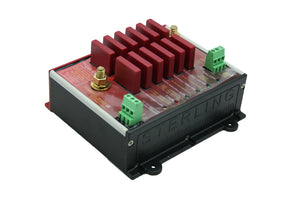 Sterling Power CVSR140 Current-Limiting Voltage Sensitive Relay, 140A
$169.10
-
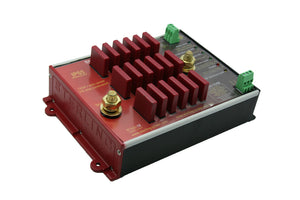 Sterling Power CVSR210 Current-Limiting Voltage Sensitive Relay, 210A
$226.10
-
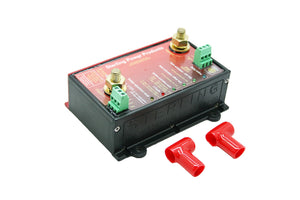 Sterling Power VSR160 Voltage Sensitive Relay, 12V/24V 160A
$47.49
-
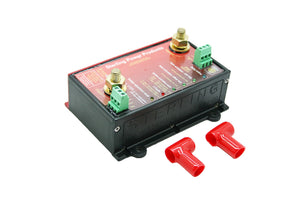 Sterling Power VSR80 Voltage Sensitive Relay, 12V/24V 80A
$38.94
-
 Sterling Power IFR12160 Ignition Feed Relay, 12V 160A
$33.24

Want the full walkthrough? Read the complete guide.