
Victron BCD diode combiner or Cyrix-i 400A: which one do I need for two batteries?
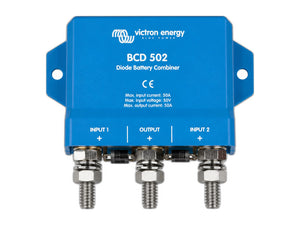
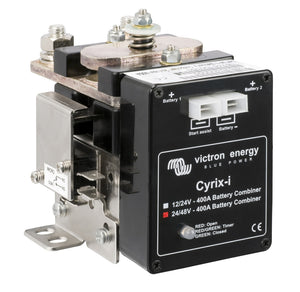
Short answer: Go by the charging current and the system voltage. The BCD is a passive diode splitter for 12V only, in 40A (BCD 402) or 80A (BCD 802), and it keeps the two banks apart all the time. The Cyrix-i is a 400A combiner for 12/24V or 24/48V that links the banks while either one is charging and has start assist.
Both let one charging source charge two batteries without the house loads flattening the starter battery. They get there in opposite ways, and their ratings barely overlap.
Side by side
| BCD (diode combiner) | Cyrix-i (intelligent combiner) | |
|---|---|---|
| How it works | Diodes split the charge into two banks. Current cannot flow back from one bank to the other. | A microprocessor senses both sides and connects the banks while either one is being charged, then separates them when charging stops |
| Banks ever connected? | Never | Yes, while charging |
| Rating | 40A (BCD 402, BCD000402000) or 80A (BCD 802, BCD000802000) | 400A |
| System voltage | 12V | 12/24V (CYR010400000) or 24/48V (CYR020400000) |
| Start assist | No | Yes |
| Batteries | 2 | Starter and house |
A three-step rule
- What voltage is the system? 24V or 48V rules out the BCD, which is listed for 12V only. Pick the Cyrix-i version that matches your voltage.
- How many amps does the charging source put out? The BCD is sized for modest setups. If the source can push more than 80A, the BCD is out and the 400A Cyrix-i is the one that fits.
- Do you want the banks joined? If you never want the starter and house batteries tied together, the BCD's passive split does that. If you want the house battery able to help start the engine, only the Cyrix-i has start assist.
Before you buy either
Neither unit has its own charge profile. Each house battery gets whatever the source supplies. For a lithium house battery or a smart alternator, read the parent guide first: it explains why Victron points those setups to an Orion DC-DC charger instead of a combiner.
Both are 2-battery parts. For three banks on one alternator, the guide covers the Argofet. Not sure which fits your rig? Send us the charging source and battery types and we will check it. We ship from Upland, California.
What you need
Want the full walkthrough? Read the complete guide.
Have a different question? Tell us your rig and what you're trying to do.
Ask an expert