
Which Renogy solar kit fits a travel trailer: 200W, 400W or 600W?
Our calculator steps through four Renogy kit sizes: 200W, 400W, 600W and 800W. Our calculator works out the array your trailer needs, then hands you the first kit that is at least that big. For most travel trailers that is the first or second rung.
How the kit is chosen
The travel-trailer preset assumes a propane fridge, a TV in the evening, a morning coffee maker or microwave, two days between recharges and about five hours of sun, parked rather than driving. That is 37Ah a day, or about 474Wh, and it works out to a 150W array. The kit ladder rounds that up to the 200W Starter Kit.
Change one thing and the kit changes with it:
| Your trailer | Array | Renogy kit |
|---|---|---|
| Preset: propane fridge, TV, coffee | 150W | 200W Starter |
| Add a laptop | 150W | 200W Starter |
| Add a furnace or diesel heater at night | 200W | 200W Starter |
| Add a Starlink Mini most of the day | 200W | 200W Starter |
| Same loads, cloudy or winter sun (3 hours) | 250W | 400W Starter |
| 12V compressor fridge instead of propane | 250W | 400W Starter |
| 12V fridge plus a Starlink Mini | 300W | 400W Starter |
| 12V fridge plus a Standard Starlink dish | 400W | 400W Starter |
| 12V fridge, Mini, furnace, laptop | 350W | 400W Starter |
| Full-timer: 12V fridge, TV, laptop, Standard dish, furnace, CPAP, coffee | 500W | 600W Essential |
| The full-timer load under winter sun | 800W | 800W Essential |
Two patterns fall out of the table. A propane-fridge trailer stays on the 200W kit through almost any single add-on. A 12V compressor fridge, on its own, moves you to the 400W kit, and once you are there the 400W kit absorbs a Starlink Mini and a furnace without changing size again.
What is in each kit
- 200W Starter Kit: 200W of panels, a Wanderer Li 30A PWM controller, cables and Z-brackets. Renogy rates it to expand to 400W, but the Wanderer accepts 25V maximum, so the extra panels have to be 12V-class. Panel output on this kit is Renogy's average 500Wh a day at five hours of sun.
- 400W Starter Kit: two 200W panels, rigid 16BB N-type or flexible, with a Rover 40A MPPT and the BT2 Bluetooth module, plus cables, connectors and mounts. The rigid set weighs 72 lb, the flexible set 42 lb.
- 600W Essential Kit: three 200W panels and a 60A MPPT controller.
- 800W Essential Kit: four 200W panels, a Rover 60A MPPT, mounts, cabling and fusing.
If you want headroom, the 400W Starter Kit is the next step. It costs more roof space, two panels instead of one, but it is the size the calculator reaches as soon as a 12V fridge or a cloudy week enters the picture, and a Rover 40A handles about 520W at 12V if you add a panel later.
The battery is not in the box
Every kit is panels and controller only. The calculator sizes the bank alongside the array: 100Ah for the preset, 150Ah with a 12V fridge or a furnace, 200Ah with a fridge and a Starlink Mini, 250Ah with a Standard dish. A Renogy Pro 100Ah or 200Ah covers the first three rows; past 200Ah the calculator steps to Renogy's compact 300Ah battery.
Run your own numbers in our RV solar & battery calculator; the link opens it pre-filled for a travel trailer, and the result includes a Renogy parts list you can add to the cart in one click.
For the full sizing walk-through by daily use, see What Size Solar Kit Do I Need for My RV?
Shop the full Renogy range at RV Parts Giant.
What you need
-
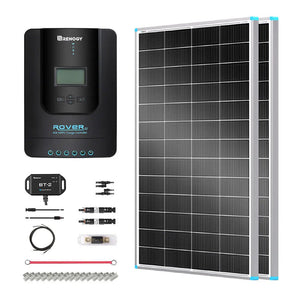 Renogy 400W 12V Starter Solar Panel Kit
$725.95
-
 Renogy 200W 12V Starter Solar Panel Kit with 30A PWM | RNG-KIT-STARTER200D-WND30-US
$193.64Out of stock
-
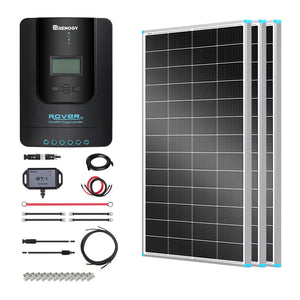 Renogy 600W 12V Essential Solar Panel Kit
$873.56
-
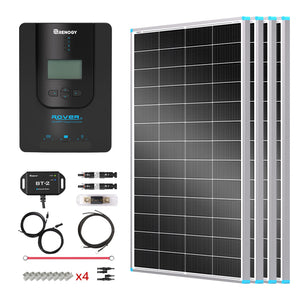 Renogy 800W 12V Essential Solar Panel Kit | RKIT800BC-R60D4
$1,253.99
-
 Renogy Pro 12V 100Ah/200Ah Smart LiFePO4 Battery
$539.93


Want the full walkthrough? Read the complete guide.