
Can the Nomadic S1 Helix replace idling or an APU for sleeper-cab cooling?
Yes, for cooling. Nomadic sells the S1 Helix as no-idle cooling for sleeper cabs and calls it an electric APU alternative. Primary fit is over-the-road trucks. The engine stays off; the S1 runs from a 12V or 48V battery bank, so the real question is how many amp-hours your rest needs and how you put them back.
How it mounts on a tractor
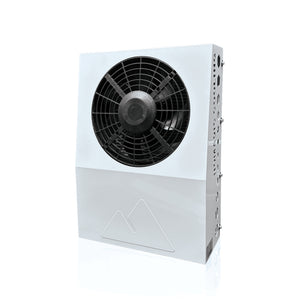
- Condenser on the back wall, outside the cab. Keep at least 4 in clear around its vents, mount it within 5 degrees of level and away from exhaust and other heat sources. Nomadic recommends a backing plate on thin metal or high-vibration installs.
- Evaporator inside the sleeper, with about 6 in of space around it and a drain that slopes downhill all the way (no kinks, no traps).
- One 2.25 in hole carries the lines, drain and harness, sealed with the supplied two-piece grommet.
- No roof cut and no added height, which matters if you run close to clearance limits.
Battery: amp-hours per hour of rest
Using Nomadic's planning averages and 90% of a LiFePO4 bank (12.8 V or 51.2 V nominal):
| Mode | 12V bank | 48V bank |
|---|---|---|
| ECO (~486 W / ~451 W) | about 42 Ah per hour | about 10 Ah per hour |
| Full AC (~879 W / ~948 W) | about 76 Ah per hour | about 21 Ah per hour |
Multiply by the hours you rest, add the fridge, CPAP and anything else on the bank, then add margin. Nomadic's own advice is not to build around the exact minimum. Nomadic's figures are planning estimates pending certification.
Putting it back while you drive
A DC-DC charger refills the house bank from the alternator between rests. The Victron Orion XS 12/12-50A charges a 12V house battery at up to 50 A and limits what it draws from the alternator, so at full output an hour of driving puts back up to about 50 Ah, a little more than an hour of ECO uses. Two can be paralleled for more current.
12V or 48V in a truck
Nomadic's view: 12V suits standard house banks and moderate rest windows; 48V draws less current, uses smaller cable and suits long hot nights. Fuse the positive line within 18 in of the battery: 100 A on 12V, 30 A on 48V.
Installation
Nomadic puts a typical professional install at about a workday per truck. You can do the wiring yourself, but a licensed technician must evacuate the lines to 500 microns or lower and charge the refrigerant (nominal 500 g, plus or minus 30 g). Nomadic gives a system ship weight of about 74.9 lb for both pieces boxed.
What you need

Want the full walkthrough? Read the complete guide.