
Should I get a 12V rooftop air conditioner or a 120V rooftop AC with an inverter for boondocking?
The numbers below come from our calculator's own settings: a 13,500 BTU rooftop unit counted at 1,400W running, a 12V rooftop unit at 750W, a 12.8V LiFePO4 bank with 85% usable, 92% inverter efficiency on the 120V unit, 75% solar harvest and 5 peak sun hours.
Same night, both units
Eight hours on a warm night (80s°F, compressor on about 55% of the time), on the calculator's travel-trailer preset (37Ah a day of other loads), one night off-grid:
| 12V rooftop, ~10,000 BTU | 120V rooftop, 13,500 BTU | |
|---|---|---|
| Current from a 12V bank while running | about 59A | about 119A |
| AC alone, 8 hours | about 258Ah | about 523Ah |
| Battery the calculator asks for | 350Ah | 700Ah |
| Solar to refill it in a day | 1,050W | 1,950W |
| Inverter for the AC | none | MultiPlus 12/3000 class |
The inverter line comes from how the calculator sizes it: 1.5 times the AC's running watts, so 2,100W, which is past the MultiPlus 2000 and lands on the 12/3000. That 119A also means heavy cable, a matching fuse, and a soft starter on the AC to tame the compressor surge.
Where the 12V unit wins
- Off-grid hours. Half the battery and about half the panel on the same night.
- No inverter in the path. The OutEquipPro Summit 2 runs straight off the house battery, parked or driving, on a pre-installed 6 AWG cord and 100A inline fuse. OutEquipPro lists 21A on Eco and 58A on Turbo.
- Same hole. The Summit 2 drops into a standard 14 x 14 in vent opening, the same opening the Fogatti InstaCool 13,500 non-ducted unit fits.
Where 120V still wins
- Cooling capacity. The Summit 2 is 10,000 BTU and the Glacier Pro 11,500 BTU. If your rig's length calls for 13,500 or 15,000 BTU, a 12V unit runs harder for longer and the battery advantage shrinks. Check our BTU by camper length guide first.
- Mostly on hookups. A 120V unit runs straight from the pedestal or generator. A 12V unit always draws from the house battery, so whatever charges that battery has to keep up with it.
- Heat. Both OutEquipPro units are cooling only. Some 120V units, such as the Eco-Cool Free Blow, add a heat pump.
A quick decision rule
- Count how many AC hours a typical trip spends off-grid. If it is most of them, lean 12V.
- Check the BTU your rig needs. If it is 13,500 or more, lean 120V and budget for the inverter, the bank and a generator to back it up.
- If you already own a working 120V unit and a big bank, add a soft starter before replacing anything.
To see both builds side by side with your own loads, pick a rooftop AC in our RV solar & battery calculator. It shows a "12V rooftop" comparison under the mains build and switches the whole plan over with one click.
What you need
-
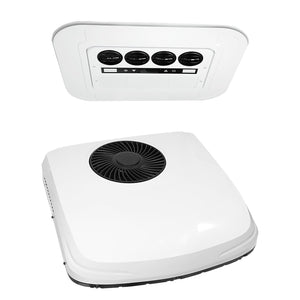 OutEquipPro Summit 2 12V Rooftop RV AC 10,000 BTU Cool Only, White
$929.83
-
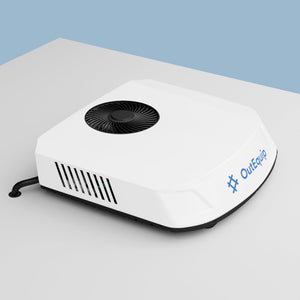 OutEquipPro Glacier Pro 12V Rooftop RV AC 11,500 BTU, White
$1,270.18
-
 Fogatti InstaCool 13,500 BTU Non-Ducted RV Rooftop Air Conditioner | Quiet, 115V
$1,062.49
-
 Victron MultiPlus 12/3000 & 24/3000 120V (UL) | RV Inverter/Charger
$1,011.99
-
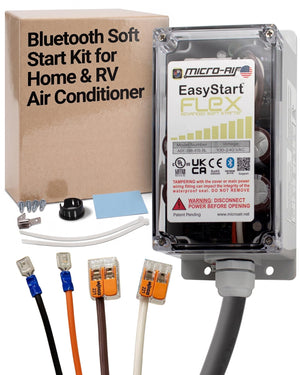 MICRO-AIR EasyStart Flex 398 Soft Starter | RV & Home AC
$498.99


Want the full walkthrough? Read the complete guide.