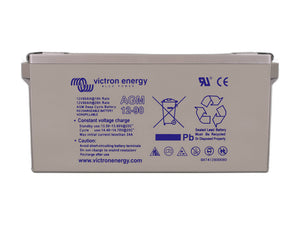
Victron AGM or Gel deep-cycle battery for an RV house bank: which one lasts longer?
Both are sealed VRLA batteries from the same maker, rated the same way (C20, a 20-hour discharge at 0.05C), and built in the same case sizes from 60Ah to 220Ah. The chemistry differs in where the electrolyte lives, and Victron's datasheet puts hard numbers on what that changes.
Service life
Victron's design life under float service, by average temperature:
| Average temperature | AGM Deep Cycle | Gel Deep Cycle |
|---|---|---|
| 20°C / 68°F | 7 to 10 years | 12 years |
| 30°C / 86°F | 4 years | 6 years |
| 40°C / 104°F | 2 years | 3 years |
Two things stand out. Gel lasts roughly half as long again, and heat halves both. A battery bay that runs at 40°C through a Southwest summer costs the Gel nine years of its rated life, so ventilation matters more than chemistry. Victron's cycle-life curve tells the same story: at any depth of discharge the Gel completes more cycles.
Capacity when you draw hard
The C20 number is only true at a 20-hour discharge. Pull faster and both give less, the Gel a little more so:
| Discharge time | AGM gives | Gel gives |
|---|---|---|
| 10 hours | 92% | 87% |
| 5 hours | 85% | 80% |
| 1 hour | 65% | 61% |
| 30 minutes | 55% | 51% |
Victron adds that a constant-power load such as an inverter shrinks capacity faster still, and the AGM is the one it recommends for high-current jobs like engine starting. That shows in the listing specs: at 90Ah the AGM is rated 400 cold-cranking amps and 130 minutes reserve against 360 and 120 for the Gel, and at 220Ah it is 650/250 against 600/220.
Storage and charging
- Self-discharge is under 2% a month at 20°C for both, doubling with every 10°C rise. Kept cool, either can sit a year without a charge.
- Both recover well from a deep discharge, but repeated deep discharge shortens any lead-acid battery's life. Size the bank so normal use stays shallow.
- Gassing starts at 14.34V on a 12V battery. A charger with Victron's adaptive curve (Battery Safe mode, variable absorption, lower storage float) is what the datasheet is written around; a plain three-stage charger will overcharge after shallow cycles.
Sizes we stock
The AGM runs from 8Ah up to 220Ah in 12V plus a 6V/240Ah block for series banks; the Gel runs 60Ah to 220Ah plus a 265Ah 12V with M8 terminals. From 60Ah up the two share case dimensions, so a Gel can replace an AGM of the same capacity in the same tray.
The rule: a house bank that cycles nightly and floats on shore power most of its life is a Gel job. A bank that also starts a generator or engine, or runs a big inverter in short bursts, is an AGM job. Both ship from our Upland, California warehouse.
Shop Victron lithium batteries, or the full Victron Energy range at RV Parts Giant.