
Argodiode or Argofet: which Victron battery isolator should I put on my alternator?
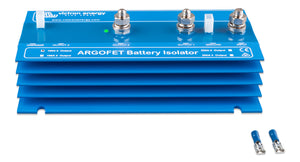
Both let one alternator charge two or three battery banks while keeping them apart, so a flat house bank never pulls the starter battery down with it. The difference is what each one costs you in charge voltage.
Voltage drop is the whole argument
| Argodiode | Argofet | |
|---|---|---|
| Technology | Schottky diodes | FETs |
| Drop at low current | about 0.3V | under 0.02V |
| Drop at rated current | about 0.45V | about 0.1V average |
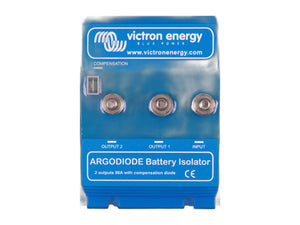
| Fix for the drop | Compensation diode on every model, used to raise the alternator's sense voltage | Not needed |
Victron's own datasheet warns that simply inserting a diode isolator between alternator and batteries lowers the charge voltage enough that the batteries never reach 100% and age early. The compensation diode cures that only if your alternator has an external sense wire you can route through it. On a vehicle alternator with internal sensing you cannot, and the Argofet is the honest answer.
Ratings and terminals
Argodiode comes in 80-2SC, 80-2AC, 100-3AC, 120-2AC, 140-3AC, 160-2AC and 180-3AC. The first number is the maximum alternator current, the second the number of batteries. Models up to 100A have M6 studs; from 120A they are M8. The energize connection and the compensation diode use 6.3 mm Faston blades. Depth grows with rating, from 75 mm to 200 mm on a 60 x 120 mm footprint, and weight from 0.5 to 1.5 kg.
Argofet comes in 100-2, 100-3, 200-2 and 200-3, all on M8 bolts, all 65 x 120 x 200 mm and 1.4 kg, auto-ranging between 12V and 24V.
Size either one to the alternator's output, not the battery bank.
The energize input
Some alternators need voltage on B+ before they start charging, and an isolator blocks the battery from supplying it. Every Argofet has a current-limited energize input you wire to the engine run/stop switch (2.5 mm² minimum). On the Argodiode only the "AC" models have it; the 80-2SC does not, so if your alternator will not self-excite, skip that one.
Cable matters more than you think
Victron's example in the Argofet sheet: 100A through 10 m of AWG0 drops 0.26V, and 50A through 5 m of AWG7 drops 0.35V. Either loss is bigger than the Argofet's own, so short, fat runs are what keep the FET advantage. Both isolators run hot and must sit on a non-flammable surface.
When the Argodiode still wins
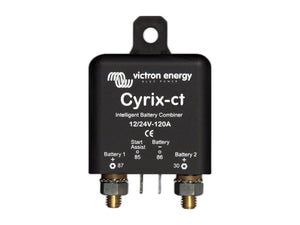
A second bank that only needs to be kept topped up, an alternator with an accessible sense wire, or a budget that stops at the cheapest unit: the 80-2AC does that job and has the energize input. If the house bank is lithium or you expect it to reach full charge from driving alone, buy the Argofet, or step over to a Cyrix-ct combiner, which has no drop at all because it is a relay.
All of them ship from our Upland, California warehouse.
Shop Victron lithium batteries, or the full Victron Energy range at RV Parts Giant.
What you need
Want the full walkthrough? Read the complete guide.