
When do I need a Victron Buck-Boost DC-DC converter instead of an Orion-Tr Smart?
Both charge a house battery from the vehicle while you drive, and both detect a running engine. The Buck-Boost costs more and is bigger, so it only makes sense when one of the following is true for your vehicle.
1. The alternator voltage swings outside a normal window
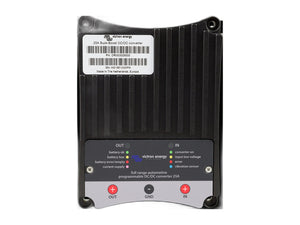
Victron built the Buck-Boost for smart alternators on Euro 5 and Euro 6 engines with regenerative braking. Those alternators run high on overrun (Victron's example is a Mercedes at 15.4V) and low when the engine control unit decides the starter battery is full. The converter accepts 10 to 30V on the input and delivers a programmed 10 to 30V on the output, bucking when the input is high and boosting when it is low, so the house battery sees one steady charge voltage either way. Its under-voltage threshold is 10V, which also protects the starter battery from being dragged down.
2. You need to cross voltages
One unit, programmed in the free PC application, charges a 12V or a 24V service battery from a 12V or a 24V alternator. The ratings change with the output voltage:
| Model | At 12V output | At 24V output |
|---|---|---|
| 25A | 25A | 15A |
| 50A | 50A | 25A |
| 100A | 100A | 50A |
A 24V truck feeding a 12V camper, or a 12V van charging a 24V bank, is the Buck-Boost's natural territory.
3. You need to cap what the alternator gives up
Output is governed by three settings: the maximum charge current, the maximum input current, and the converter's own temperature limit. The input limit is the one a small factory alternator needs; you can hold the draw below what it can cool itself at, instead of hoping the house battery takes less.
4. You want the vehicle to switch it
Besides the built-in engine-running detection, the converter can be triggered from the D+ terminal, the ignition (+15) line, or the CAN bus on the 50A and 100A models (the 25A has no CAN input). The LEDs tell you why it is off: yellow for input below threshold, blue slow-flash for activation blocked by low input, red for over temperature.
What you give up
- Size and weight: 165 x 120 x 30 mm and 0.6 kg for the 25A, 213 x 120 x 30 mm and 1.4 kg for the 50A, and a 288 x 162 x 95 mm, 4.1 kg block for the 100A.
- Programming needs a laptop and a USB A-to-B cable; there is no Bluetooth app.
- Non-isolated only, so vehicle and house negatives are common.
- It is a converter with a charge voltage, not a multi-stage charger. If your battery maker wants a specific absorption and float profile, the Orion-Tr Smart or Orion XS gives you one.
If your alternator is conventional, the voltages match and the battery is lithium or AGM with a published profile, stay with the Orion-Tr Smart. All three ship from our Upland, California warehouse.
Shop Victron Orion DC-DC chargers, or the full Victron Energy range at RV Parts Giant.
What you need


Want the full walkthrough? Read the complete guide.