
Do I need a battery monitor like a Victron SmartShunt in my RV?
You need one if
- The bank is wired into the RV and charged from two or more places: roof solar, a DC-DC charger while driving, the converter or an inverter-charger on shore power. Each charger only knows what it put in. The shunt sits on the battery negative and counts everything in and out, so it is the one place that knows the real state of charge.
- You size your system from estimates. Every load figure in our calculator is an average. The shunt's history (amp-hours consumed overnight, deepest discharge) turns those averages into your real numbers. After a week you will know whether you bought too much battery or too little.
- You run anything big through an inverter. A 13,500 BTU rooftop AC pulls about 119A from a 12V bank while it runs, by the calculator's figures. Time remaining at that rate is the number you want to see before bed.
You can skip it if
- Your power is a portable power station. A station is a sealed unit with its own battery and screen. There is no house-bank negative to put a shunt on.
- You have Victron Lithium NG batteries with an NG BMS. Both NG BMS models read state of charge from the batteries. See do I need a SmartShunt with a SmallBMS NG or VE.Bus BMS NG.
What the calculator adds for each answer
| Monitoring answer | Victron build | Renogy build |
|---|---|---|
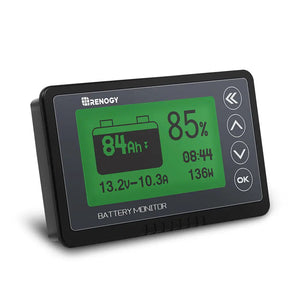
| Check it on my phone | SmartShunt 500A (Bluetooth) | Renogy 500A monitor with shunt |
| Full monitoring, screen, remote access | Cerbo GX MK2 + GX Touch 50 + SmartShunt | Renogy 500A monitor with shunt |
| Nothing | none, with a warning that you are guessing | none |
Prefer a wall gauge to a phone app? The BMV Smart does the same job with its own display.
Which size
Size the shunt to the current through it, not to the battery. Battery capacity is just a setting (1-9,999Ah).
- 500A covers most single-inverter RVs, including a 12V MultiPlus 12/3000. Our listing estimates that inverter at about 215A continuous.
- 1000A is for a 12/4000 or two inverters.
- 2000A is only for systems that genuinely run past 1000A.
Larger shunts carry a larger zero offset: 10mA for the 300/500A, 20mA for the 1000A and 40mA for the 2000A. Don't oversize "for safety." The standard shunt is IP21 (dry locations only), so choose the IP65 version if it will sit where it can get wet.
Two extras are worth knowing. The second input can read your starter battery voltage. The VE.Direct port links it to a Cerbo GX later, but the cable is not included.
To see where the shunt sits in a full build, answer the monitoring question in our RV solar & battery calculator.
What you need



Want the full walkthrough? Read the complete guide.